Applications of Ultrapure Water Equipment in the Medical Industry
Ultrapure water equipment plays an important role in the medical industry. It is mainly used for medical instrument cleaning, laboratory testing, pharmaceutical water preparation, diagnostic reagent production, and water supply for hospital sterile supply departments. Since the medical industry has high requirements for water cleanliness, stability, and safety, ordinary tap water or general purified water often cannot meet relevant application standards. Ultrapure water equipment can continuously provide high-quality water through pretreatment, reverse osmosis, EDI, UV sterilization, terminal precision filtration, and other processes.
1. Application of Ultrapure Water Equipment in Medical Instrument Cleaning
Medical instruments often retain blood, tissue debris, drug residues, proteins, and other organic contaminants after use. If the cleaning water quality is not qualified, scale, corrosion, stains, or microbial residues may remain on the instrument surface, affecting subsequent disinfection and sterilization. Therefore, ultrapure water plays an important role in medical instrument cleaning.
1.1 Improving the Cleanliness of the Cleaning Environment
Ultrapure water contains almost no microorganisms, organic matter, or suspended impurities. It can effectively reduce the possibility of bacterial growth and provide a cleaner and safer cleaning environment for medical instruments. For surgical instruments, endoscopic instruments, dental instruments, and precision medical components, clean water quality helps improve cleaning performance.
1.2 Reducing Water Marks and Mineral Residues
Compared with ordinary water, ultrapure water contains extremely low levels of minerals, calcium and magnesium ions, and electrolytes. After cleaning, it is less likely to leave water marks, white spots, or scale on the instrument surface. This not only keeps the instrument surface clean but also reduces the risk of corrosion, discoloration, and contamination of metal instruments.
1.3 Assisting in the Removal of Organic Contaminants
During medical instrument cleaning, ultrapure water can work more effectively with cleaning agents to help dissolve, disperse, and remove contaminants such as blood, proteins, and tissue residues. This improves cleaning efficiency and reduces the time cost caused by repeated manual cleaning.
1.4 Protecting Precision Medical Equipment
Some medical instruments have complex structures and precision components, such as endoscopes, minimally invasive surgical instruments, and laboratory testing instrument parts. Since ultrapure water does not contain hard mineral particles or impurities, it can reduce wear, blockage, and damage to precision components, helping to extend the service life of equipment.
2. Application of Ultrapure Water Equipment in Pharmaceutical Water Use
The pharmaceutical industry has extremely strict requirements for water quality. Microorganisms, pyrogens, endotoxins, ionic impurities, and organic contaminants in water may affect drug quality. Therefore, ultrapure water equipment is widely used in pharmaceutical production, raw material preparation, equipment cleaning, and laboratory analysis.
2.1 Ensuring Water Purity for Pharmaceutical Production
Ultrapure water has high purity and stable quality, helping to reduce the influence of impurities in water on drug composition, stability, and safety. In pharmaceutical production, clean and reliable water quality is an important foundation for ensuring product quality.
Especially in the production of injections, oral liquids, eye drops, diagnostic reagents, and other products, water quality is directly related to the safety and compliance of the final product.
2.2 Removing Microorganisms, Pyrogens, and Endotoxins
With a reasonable configuration of reverse osmosis, EDI, UV sterilization, ultrafiltration, and terminal filtration systems, ultrapure water equipment can effectively reduce the risk of bacteria, pyrogens, endotoxins, and particle contamination in water, providing a safer and more stable water source for pharmaceutical production.
It should be noted that water for injection usually needs to comply with pharmacopoeia standards and requires a dedicated pharmaceutical water system. It should not be simply regarded as the same as ordinary ultrapure water.
2.3 Suitable for the Production of Various Pharmaceutical Dosage Forms
In pharmaceutical production, ultrapure water can be used in the production and auxiliary processes of various dosage forms, including:
- Water for injection production
- Oral liquid preparation
- Eye drop production
- Diagnostic reagent preparation
- API production process water
- Pharmaceutical equipment cleaning water
- Laboratory analysis and testing water
A high-quality water source can help pharmaceutical companies control contamination risks, improve product stability, and ensure production consistency.
3. Advantages of Using Ultrapure Water Equipment in the Medical Industry
For hospitals, medical device manufacturers, pharmaceutical factories, and laboratories, installing stable and reliable ultrapure water equipment offers the following advantages:
- Improves the cleaning quality of medical instruments
- Reduces the risk of corrosion and residue on instruments
- Enhances pre-treatment performance before disinfection and sterilization
- Meets the demand for high-purity water in laboratories and pharmaceutical production
- Reduces the impact of water quality fluctuations on testing and production results
- Supports standardized and regulated water management in the medical industry
4. Recommended Configuration of Ultrapure Water Equipment for Medical Applications
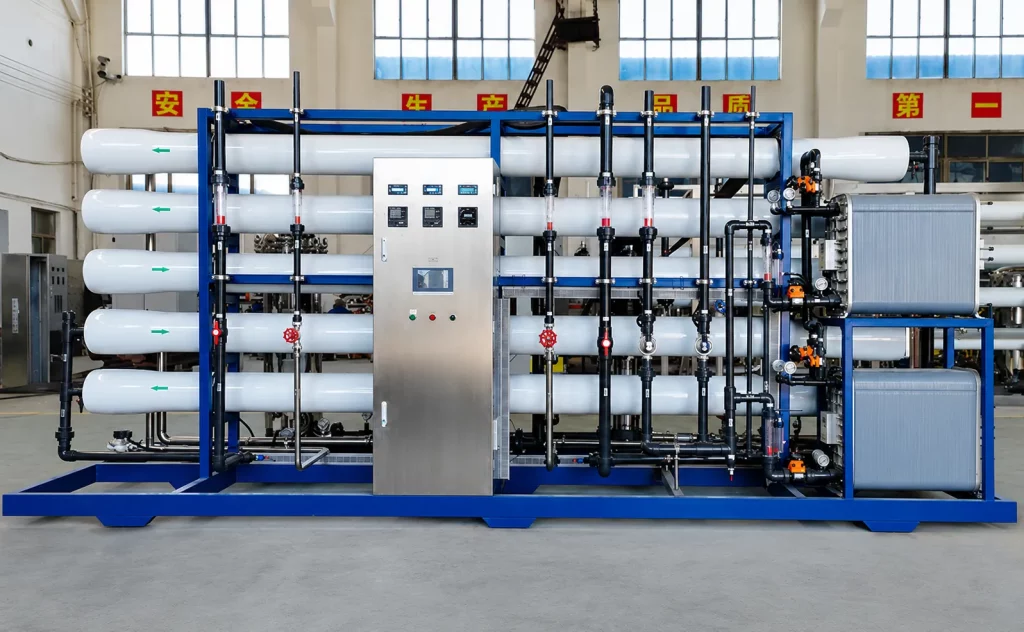
Ultrapure water equipment for the medical industry can usually be customized according to actual water demand. A common process flow includes:
Raw Water Tank → Raw Water Pump → Multi-Media Filter → Activated Carbon Filter → Water Softening System → Precision Filter → Reverse Osmosis System → EDI System → UV Sterilization → Terminal Filtration → Ultrapure Water Point of Use
Different application scenarios have different requirements for water quality, conductivity, TOC, microbial indicators, and water production capacity. Therefore, when selecting equipment, the system should be designed according to the actual needs of hospital sterile supply departments, pharmaceutical workshops, laboratories, or medical instrument cleaning centers.
5. Conclusion
Ultrapure water equipment is widely used in the medical industry, especially in medical instrument cleaning and pharmaceutical water preparation. It provides a high-cleanliness, low-residue, and low-microbial-risk water source, helping medical institutions and pharmaceutical companies improve cleaning efficiency, ensure product quality, and reduce contamination risks.
For users with medical water, pharmaceutical water, or laboratory pure water needs, choosing a professional ultrapure water equipment manufacturer and customizing the system according to actual water quality standards and water consumption requirements is the key to long-term stable operation.









 June 17, 2026