- Product Overview
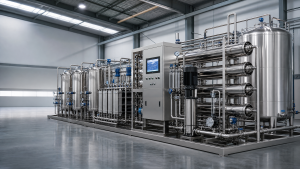
A large-scale ultrapure water system is an industrial water treatment solution designed for high-capacity production and stable, continuous supply of high-purity water. Compared with standard purified-water equipment, a large-scale ultrapure water system must provide higher treatment capacity, stricter water quality control, long-term continuous operation, automated management, online monitoring, stable distribution, and convenient maintenance.
These systems are widely used in semiconductors, electronics, photovoltaics, pharmaceuticals, chemicals, laboratories, precision manufacturing, surface treatment, automotive components, and new-energy industries. Ultrapure water can be used for wafer cleaning, chip manufacturing, solar-cell cleaning, pharmaceutical production, laboratory analysis, precision instrument cleaning, process solution preparation, and production-line rinsing, providing reliable process water for applications with demanding water quality requirements.
Large-scale ultrapure water systems are commonly designed as modular, skid-mounted, or fully integrated systems. A complete system may include pretreatment, reverse osmosis, advanced demineralization, final polishing, storage and recirculation, automatic control, and online monitoring. The system can be customized according to raw water quality, required capacity, water quality specifications, available plant space, and process-water requirements.
- Main Applications
2.1 Semiconductor and Electronics Industries
During semiconductor and electronic-component manufacturing, wafers, chips, printed circuit boards, and precision components are highly sensitive to ions, particles, organic matter, and microorganisms in water. A large-scale ultrapure water system can provide stable high-purity or ultrapure water for wafer cleaning, chip manufacturing, PCB cleaning, and electronic-component surface treatment, helping reduce the impact of water quality fluctuations on product yield and production stability.
2.2 Photovoltaic and New-Energy Industries
In the production of photovoltaic wafers, solar cells, and modules, ultrapure water is commonly used for wafer cleaning, texturing, chemical cleaning, and equipment rinsing. Lithium batteries, energy-storage batteries, and other new-energy products also require stable process water. According to the scale of the production line, the system can be designed for continuous supply and combined with storage tanks and recirculation piping to serve multiple points of use.
2.3 Pharmaceutical and Biotechnology Industries
Pharmaceutical manufacturing, laboratory preparation, biotechnology, and medical-related applications often require high standards of water quality, hygiene, and stability. A large-scale ultrapure water system can be combined with ultraviolet sterilization, ozone disinfection, terminal filtration, and recirculation to provide process water, equipment-cleaning water, laboratory water, and other water required by the project. The final configuration and water quality specifications should be determined according to the applicable regulations, process standards, and validation requirements.
2.4 Chemical and Precision-Manufacturing Industries
Chemical processing, coating, electroplating, optical products, precision instruments, and automotive-component manufacturing may require the reduction of salts, hardness, particles, and organic contaminants that could affect products or equipment. Ultrapure water systems can be used for product cleaning, process solution preparation, surface treatment, boiler makeup water, and other production processes.
2.5 Laboratories and Research Institutions
For large laboratories, testing centers, universities, research institutions, and corporate R&D centers, the system can provide centralized water production, storage, and recirculation according to the number of laboratories, frequency of use, and required water quality grade. This can reduce the management and maintenance burden associated with multiple decentralized systems.
- Typical Treatment Process
A large-scale ultrapure water system generally uses multiple treatment stages to progressively remove particles, residual chlorine, hardness, salts, organic matter, microorganisms, and dissolved impurities from the raw water. A typical process flow is:
Raw Water → Raw Water Tank → Raw Water Pump → Quartz Sand Filter → Activated Carbon Filter → Water Softener or Antiscalant Dosing System → Cartridge Filter → Primary Reverse Osmosis (RO) → Intermediate Water Tank → Secondary RO or Two-Pass RO → Electrodeionization (EDI) → Ultraviolet Sterilization → Polishing Mixed Bed or Ion Exchange → Ultrafiltration / Terminal Precision Filtration → Pure Water Tank → Recirculation System → Points of Use
3.1 Raw-Water Storage and Pressurization
Raw water enters the raw-water tank for centralized storage and flow balancing. The raw-water pump transfers water to the pretreatment system and provides a stable flow rate and pressure for the downstream filtration units. Large projects may include liquid-level control, low-level protection, and standby pump sets to improve supply reliability.
3.2 Pretreatment System
The pretreatment section may include quartz sand filtration, activated carbon filtration, water softening, cartridge filtration, and chemical dosing systems where required. The quartz sand filter removes sediment, rust, suspended solids, and relatively large particles. The activated carbon filter primarily reduces residual chlorine, odors, and part of the organic matter. A water softener or antiscalant system helps reduce the risk of hardness scaling and protects the RO membranes. The cartridge filter provides additional fine filtration and helps prevent small particles from entering the high-pressure pump and membrane elements.
3.3 Reverse Osmosis System
Reverse osmosis is the core desalination process in most large purified-water and ultrapure-water systems. After pressurization by the high-pressure pump, the feed water passes through RO membrane elements. Water molecules pass through the membrane under pressure, while most dissolved salts, heavy metals, microorganisms, colloids, and organic contaminants are retained. Large systems commonly use multiple membrane housings arranged in parallel or in stages to meet high flow requirements and continuous operating demands. Depending on the required water quality, the system may use primary RO, secondary RO, or multiple RO stages.
3.4 Advanced Demineralization with EDI
Electrodeionization (EDI) is normally installed downstream of the RO system for further removal of dissolved ions. EDI combines ion-exchange membranes, ion-exchange resin, and an electric field to continuously demineralize RO permeate. Compared with conventional chemically regenerated mixed beds, EDI does not require frequent acid and caustic regeneration during normal operation, making it suitable for projects that require continuous supply, automated operation, and stable water quality.
3.5 Final Polishing and Disinfection
To further protect final water quality, the system may be equipped with ultraviolet sterilization, polishing mixed beds, ultrafiltration, terminal precision filtration, or other suitable treatment units. Ultraviolet equipment is mainly used to control the risk of microorganisms in recirculating water. A polishing mixed bed can further reduce ionic content and improve resistivity. Ultrafiltration and precision filtration help reduce particles, colloids, and some microorganisms from entering the final distribution piping.
3.6 Storage and Recirculation
The treated ultrapure water is collected in a pure-water tank or ultrapure-water storage tank. To reduce changes in water quality during storage and distribution, large systems commonly use a recirculation design. A recirculation pump continuously sends water to the points of use, while the return line brings the water back to the storage or circulation loop. Depending on process requirements, the loop may include ultraviolet treatment, additional filtration, heat exchange, pressure control, and online monitoring.
- Main Equipment Components
| System Unit |
Main Function |
| Raw-water tank and pump |
Store raw water, balance flow, and provide stable feed water. |
| Quartz sand filter |
Remove sediment, suspended solids, and larger particles. |
| Activated carbon filter |
Reduce residual chlorine, odors, and part of the organic matter. |
| Water softener or antiscalant system |
Reduce hardness scaling and protect the RO membranes. |
| Cartridge filter |
Provide fine filtration and protect pumps and membrane elements. |
| High-pressure pump |
Provide the operating pressure required by the RO membranes. |
| RO membrane system |
Remove most dissolved salts, microorganisms, and other contaminants. |
| EDI module |
Provide continuous advanced demineralization after RO. |
| Ultraviolet unit |
Help control microbial risk in the water system. |
| Polishing mixed bed or ion exchanger |
Further reduce ionic content and improve water purity. |
| Ultrafiltration and terminal filtration |
Reduce particles, colloids, and selected microorganisms. |
| Pure-water tank and recirculation pump |
Store, circulate, and distribute ultrapure water. |
| PLC control cabinet |
Provide automatic control, status display, and fault alarms. |
| Online monitoring instruments |
Monitor conductivity, resistivity, pressure, flow, tank level, and other parameters. |
- Intelligent Control and Online Monitoring
Large-scale ultrapure water systems commonly use PLCs, touchscreens, or industrial control systems for centralized operation. According to tank level, raw-water availability, system pressure, production flow, and water quality data, the system can automatically execute start-up, shutdown, replenishment, flushing, recirculation, and alarm procedures.
Operators can view equipment status, process parameters, and alarm records through the human-machine interface. The system may also include user-access management, operating-data recording, remote communication, and maintenance reminders. For continuous-production projects, the automatic control system can be combined with standby pumps, bypass piping, and interlock protection to improve supply continuity and operational safety.
Common online monitoring parameters include conductivity, resistivity, pressure, flow rate, tank level, and temperature. Additional water quality monitoring can be configured according to the required output specification, process characteristics, and customer acceptance criteria.
- Main Product Advantages
6.1 Suitable for High-Flow, Continuous Supply
Large-scale ultrapure water systems can use multiple membrane trains, pump sets, and modular parallel configurations to provide stable continuous flow. This allows the system to serve multiple production lines and points of use at the same time.
6.2 Stable Product Water Quality
Through the combined use of pretreatment, RO, EDI, polishing mixed beds, and terminal filtration, the system progressively reduces particles, salts, ions, organic matter, and microbial risk. Online monitoring and recirculation further help maintain stable water quality at the points of use.
6.3 High Degree of Automation
The system can provide automatic operation, flushing, water replenishment, tank-level control, fault alarms, and interlock protection. This reduces manual intervention and improves management efficiency at the production site.
6.4 Robust Construction and Easy Maintenance
The equipment can be manufactured with stainless-steel frames, sanitary piping, and a modular layout. The clear structure facilitates routine inspection, cartridge replacement, membrane maintenance, and instrument calibration. Large projects can also be designed with dedicated maintenance access and operating space.
6.5 Energy-Conscious and Manageable Operating Costs
By selecting suitable membrane arrangements, pump sets, recovery rates, recirculation methods, and control logic, the system can reduce unnecessary operation and water or power consumption. For large projects, energy-saving measures can be developed according to operating hours, water-use profiles, and discharge requirements.
6.6 Flexible Customization
The system can be configured according to plant height, equipment layout, raw-water quality, required capacity, supply pressure, number of water outlets, and final water quality specifications. Skid-mounted, cabinet-type, floor-mounted, and split-installation solutions are all possible depending on site conditions.
- Customized Design Service
Large-scale ultrapure water projects normally require detailed process confirmation and an evaluation of site conditions before equipment manufacturing begins. Important design information includes the raw-water source and analysis report, target water quality, rated production capacity, peak water demand, operating schedule, storage volume, supply pressure, drainage conditions, available installation space, and electrical requirements.
Based on this information, the appropriate pretreatment process, number of RO stages, EDI configuration, final polishing method, recirculation-piping material, storage-tank capacity, control system, and online monitoring points can be determined. For electronics, semiconductor, photovoltaic, pharmaceutical, and new-energy applications, the design should also consider the specific production process and customer acceptance requirements.
We can provide one-stop project support, including process design, equipment selection, three-dimensional layout, piping and electrical design, equipment manufacturing, on-site installation, system commissioning, operator training, and after-sales maintenance. Before shipment, the system can be tested according to project requirements, including water quality, flow, pressure, automatic control, alarm functions, and safety protection.
- Installation, Commissioning, and Maintenance
After installation, large-scale ultrapure water equipment requires a comprehensive inspection of the piping, electrical system, instruments, pumps, membrane elements, and control program. The commissioning process may include individual equipment testing, system flushing, pretreatment testing, RO testing, EDI or ion-exchange testing, storage and recirculation testing, online-instrument calibration, and alarm-function verification.
During daily operation, the operator should regularly check filter differential pressure, RO operating pressure, production flow, water quality data, tank level, and recirculation status according to the equipment manual and maintenance schedule. Cartridges, activated carbon, softening resin, RO membranes, EDI modules, and polishing mixed beds should be serviced or replaced according to operating data and changes in water quality. Proper pretreatment and scheduled maintenance help extend the service life of membrane elements and other critical components.
- Conclusion
A large-scale ultrapure water system is an integrated industrial water treatment solution that combines multi-stage purification, advanced demineralization, final polishing, automatic control, and recirculating distribution. It not only meets the demand for ultrapure water in large-scale production, but also provides stable, reliable, and continuous process-water support through online monitoring, intelligent control, and customized design.
According to the requirements of different industries and applications, the system can be flexibly configured with pretreatment, RO, EDI, ultraviolet sterilization, polishing mixed bed, ultrafiltration, terminal filtration, and recirculation units. Through sound process design, reliable equipment manufacturing, and complete project support, large-scale ultrapure water systems can meet the demanding water quality requirements of electronics, semiconductors, photovoltaics, pharmaceuticals, chemicals, laboratories, and new-energy industries.








 September 04, 2026