Introduction
In a reverse osmosis water purification system, the membrane element is the core separation component, but the membrane housing is just as important for stable operation. The membrane housing holds the RO membrane in place, withstands system pressure, maintains sealing performance, and helps ensure that feed water passes through the membrane correctly.
For industrial water treatment projects, choosing the wrong membrane housing may lead to leakage, unstable pressure, shorter membrane life, difficult maintenance, or reduced water quality. That is why membrane housing selection should be considered during the design stage of a reverse osmosis system, pure water system, ultrapure water system, seawater desalination system, or water reuse project.
Shandong sinrichtec Analytical Instrument Co., Ltd. provides integrated water treatment equipment and engineering solutions, including reverse osmosis systems, ultrapure water systems, ultrafiltration equipment, seawater desalination systems, high-salinity water treatment, wastewater zero discharge, sewage treatment, and reclaimed water reuse systems. Based on different water sources, operating pressure, system capacity, and application requirements, Xinrui helps customers select suitable equipment configurations for stable long-term operation.
What Is a Membrane Housing in a Reverse Osmosis System?
A membrane housing is the pressure vessel or container used to install and protect RO membrane elements. In a reverse osmosis system, feed water enters the membrane housing under pressure, passes across or through the membrane surface, and is separated into permeate water and concentrate water.
The membrane housing must support several key functions:
- Hold the membrane element securely
- Maintain correct water flow direction
- Prevent leakage during pressurized operation
- Protect the membrane from external damage
- Support stable sealing at the end caps and ports
- Match the system’s working pressure and water treatment capacity
For small commercial systems, the membrane housing may be relatively simple. For industrial RO systems, seawater desalination systems, high-pressure systems, and large water treatment projects, membrane housing quality becomes much more important.
Common Types of RO Membrane Housing Materials
Membrane housings can be made from different materials. Each material has its own advantages, limitations, and suitable application range. The most common types include PP plastic membrane housing, transparent glass tube membrane housing, stainless steel membrane housing, and FRP membrane housing.
PP Plastic Membrane Housing
PP plastic membrane housing is lightweight, elastic, and commonly used in small water purification equipment. It can work with standard membrane elements and is often selected for low-pressure or smaller-flow systems.
Advantages
PP membrane housing is relatively light and easy to install. It is cost-effective and suitable for many simple water purification applications.
Limitations
Its pressure resistance, wear resistance, aging resistance, and long-term durability are lower than stainless steel or FRP. If system pressure is too high, the outer wall may be damaged, which can increase the risk of leakage.
Suitable Applications
PP membrane housing is more suitable for small commercial water purification systems, low-pressure RO systems, and applications with lower operating requirements.
Transparent Glass Tube Membrane Housing
Transparent glass tube membrane housing allows users to visually observe the membrane condition during operation. Its pressure resistance is generally better than ordinary plastic housing.
Advantages
The transparent structure makes it easy to observe the membrane and internal water flow condition. This can be useful in special demonstration, testing, or laboratory scenarios.
Limitations
Glass is fragile, so it is not widely used in industrial water treatment projects. It is not the preferred choice for most factory-level or high-pressure RO systems.
Suitable Applications
Transparent glass tube membrane housing is mainly suitable for special industries, display systems, testing equipment, or laboratory applications where visibility is more important than heavy-duty durability.
Stainless Steel Membrane Housing
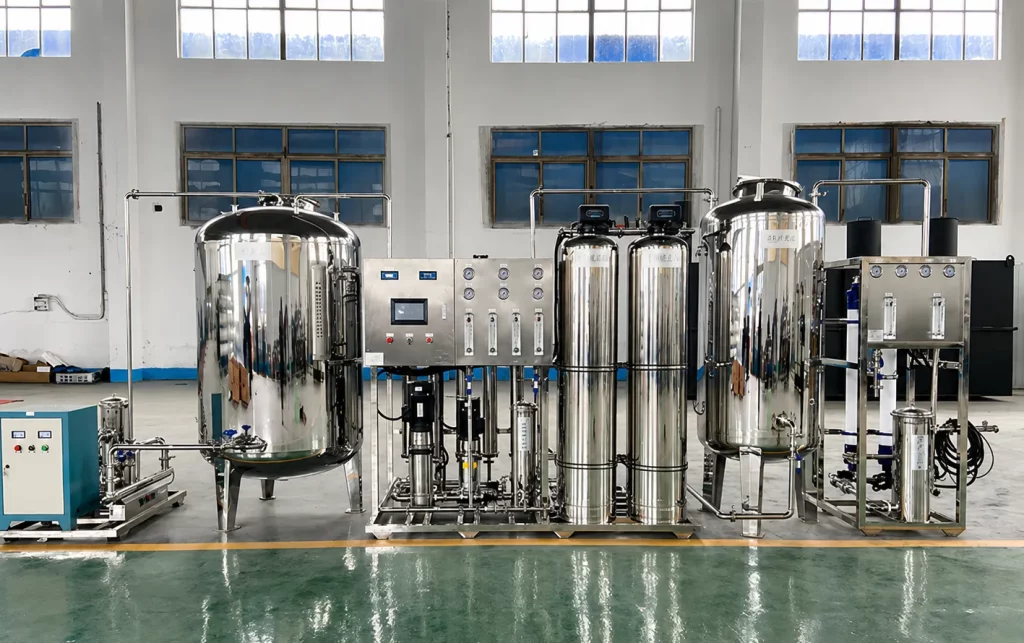
Stainless steel membrane housing is widely used in commercial and industrial water purification equipment. It has good pressure resistance, anti-aging performance, and mechanical strength.
Advantages
Stainless steel membrane housing has strong structural stability and can meet the operating pressure requirements of many industrial RO systems. It is also durable and suitable for long-term equipment operation.
Common stainless steel membrane housings may be designed with different end cap sealing forms, such as clamp type, flange type, or built-in type. According to the inlet water structure, they may also be designed as end-entry or side-entry membrane housings.
Limitations
Stainless steel housing usually has higher material and processing requirements, so the cost is higher than plastic options. For some corrosive water conditions, material grade and corrosion resistance should be carefully confirmed.
Suitable Applications
Stainless steel membrane housing is suitable for industrial pure water systems, food and beverage water treatment, pharmaceutical process water, laboratory water systems, ultrapure water pretreatment, and other projects that require clean structure and stable pressure resistance.
FRP Membrane Housing
FRP membrane housing, also known as fiberglass reinforced plastic membrane housing, is a common choice for industrial RO systems. It is typically made from epoxy resin and fiber through controlled winding and forming processes.
Advantages
FRP membrane housing offers strong pressure resistance, temperature resistance, corrosion resistance, and insulation performance. Compared with some metal and plastic materials, FRP performs well in long-term water treatment environments.
Its corrosion resistance is especially useful in seawater desalination, brackish water treatment, high-salinity water treatment, and industrial RO systems where the water may contain salts or other corrosive components.
FRP membrane housing also has good structural design flexibility. The cylinder body, head, opening position, and sealing components can be designed to support stable pressure operation and safe installation.
Limitations
FRP housing should still be selected according to system pressure, membrane size, operating temperature, connection method, and project environment. Incorrect model selection may still cause installation or operating problems.
Suitable Applications
FRP membrane housing is suitable for industrial reverse osmosis systems, seawater desalination systems, brackish water RO systems, high-salinity water concentration systems, wastewater reuse RO systems, and large water treatment projects.
Stainless Steel vs. FRP Membrane Housing: Which One Should You Choose?
For many industrial projects, stainless steel and FRP are the two most practical options. The right choice depends on water quality, operating pressure, corrosion risk, system design, project budget, and maintenance requirements.
Choose stainless steel membrane housing when:
- The project requires a clean and durable structure
- The system is used for commercial or industrial pure water
- Mechanical strength and pressure resistance are important
- The operating environment is relatively stable
- The buyer prefers stainless steel equipment appearance and structure
- Choose FRP membrane housing when:
- The system handles seawater, brackish water, or high-salinity water
- Corrosion resistance is a major requirement
- The RO system operates under higher pressure
- The project needs long-term stable industrial operation
- The system is part of desalination, wastewater reuse, or high-salt treatment
In many industrial RO projects, FRP membrane housing is widely selected because of its balance of pressure resistance, corrosion resistance, and long-term operating performance. Stainless steel membrane housing is also valuable when hygiene, strength, appearance, and structural durability are key considerations.
Key Factors to Consider Before Selecting RO Membrane Housing
1. Operating Pressure
The membrane housing must match the system’s operating pressure. Low-pressure pure water systems, brackish water systems, and seawater desalination systems may require different pressure ratings.
2. Membrane Size and Quantity
The membrane housing length should match the number and size of membrane elements installed inside. A wrong size may cause poor sealing, incorrect flow, or installation difficulty.
3. Water Quality and Corrosion Risk
For water with high salinity, chloride, acid, alkali, or other corrosive components, corrosion resistance is very important. FRP may be more suitable for many corrosive water conditions.
4. Application Industry
Different industries have different requirements. Electronics, pharmaceuticals, food and beverage, chemical processing, power plants, laboratories, and seawater desalination projects may require different housing materials and system configurations.
5. Installation and Maintenance
The membrane housing should be easy to install, open, seal, and maintain. End cap design, port layout, and space for membrane replacement should be considered during system layout design.
6. System Lifecycle Cost
A low-cost membrane housing may reduce initial investment, but if it causes leakage, frequent replacement, or maintenance problems, the total lifecycle cost may be higher. Industrial buyers should evaluate both initial cost and long-term operation stability.
How Xinrui Supports RO System Configuration
Sinrichtec provides project-based water treatment equipment and integrated solutions for different water sources, capacities, and application standards. For reverse osmosis systems, membrane housing selection is only one part of the complete design.
A complete RO system may also involve:
- Pretreatment filtration
- Ultrafiltration
- RO membrane selection
- Membrane housing selection
- High-pressure pump configuration
- Dosing and antiscalant system
- Online water quality monitoring
- PLC control
- Cleaning and maintenance design
- Post-treatment or EDI polishing
For pure water systems, ultrapure water systems, seawater desalination, wastewater reuse, and high-salinity water treatment projects, Xinrui can help customers review feed water quality, target water output, system capacity, and operating requirements before selecting the suitable process route and equipment configuration.









 June 18, 2026